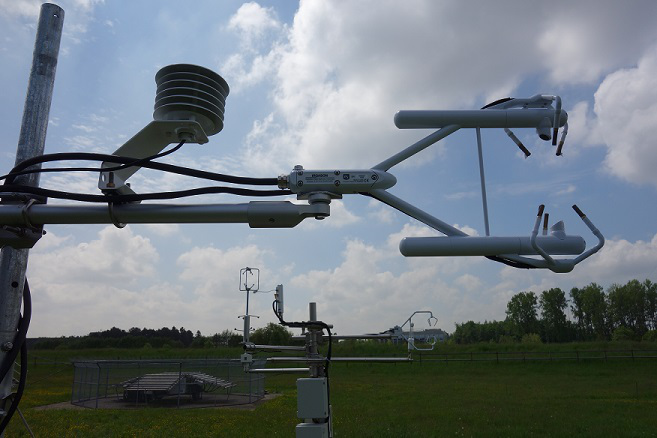
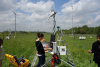
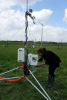
As part of their work on evapotranspiration measurements, Cerema Ile-de-France sought to test different measurement methods over small areas (a few tens to hundreds of square meters). There did not appear to be a truly suitable method. Comparing different methods, the one that could be developed and adapted was the eddy-covariance method. However, as the method was developed for agricultural areas, it was not typically used for small areas due to unclearly defined application conditions, particularly regarding the complexity of turbulent flows near the ground surface. Cerema Ile-de-France, therefore, desired to evaluate the possibility of measuring evapotranspiration fluxes over small urban areas using the eddy-covariance method.
To reduce the size of the contributing areas, lowering the measurement height seemed promising. To test the limits of the minimum measurement height and its effect on turbulence measurement and footprints, Cerema Ile-de-France collaborated with SIRTA to conduct comparative studies. Measurements taken with an IRGASON™ will be compared with those obtained from a CSAT3-LI-7500 system. Initially, the comparison will be made at a measurement height of 2.5 m. If this first comparison is satisfactory, the CSAT3-LI-7500 system will be used as a reference, and then the IRGASON measurement height will be progressively lowered to 1.50 m and then 0.8 m.
Quality control and footprint analyses will then be performed to verify the validity of the low-height measurements in small contributing areas.